AI Is Not a Content Problem. It Is a Learning Environment Problem.

AI can produce a polished answer in seconds. The educational question is whether, and under what conditions, it helps learners develop new capabilities.
Long before generative AI could produce a polished essay in seconds, I learned something that has guided my teaching for more than three decades: understanding cannot be transferred intact from one mind to another.
I earned my PhD at the University of Michigan, where I studied with environmental psychologists Rachel and Stephen Kaplan. The Kaplans taught me to think of human understanding as a collection of mental models: simplified, interconnected representations that allow us to recognize patterns, anticipate what might happen next, weigh alternatives, and act.
A teacher can provide information, examples, questions, and guidance. But it is the learner who must construct the mental models that lead to understanding. No one else can do that work for them.
Generative AI makes the distinction between receiving an answer and building understanding more consequential than ever. It can produce the outward appearance of understanding with astonishing speed. It can write the essay, organize the argument, explain the theory, solve the problem, and polish the prose. What it cannot tell us is whether the person presenting that work has developed a corresponding understanding or simply acquired its convincing exterior.
For years, educators could treat a finished product as evidence of the thinking required to produce it. That inference is no longer safe. A polished product today may represent sustained inquiry, judgment, and revision. It may also represent a well-phrased prompt and thirty seconds of waiting.
This troubles me. It also presents one of the most interesting design challenges of my career.
Mental models must be built
In “The Joys and Struggles of Building Mental Models,” Rachel Kaplan describes mental models as “the basis of understanding, reasoning, prediction, and action.” We begin building them in infancy and continue throughout our lives. They develop through experience, repetition, variation, exploration, and attempts to connect unfamiliar information with something we already understand.
Building a mental model requires active engagement and very often, a good deal of work. Understanding an explanation in the moment does not guarantee that it will leave a durable trace. Learners need opportunities to ask what if, make predictions, test relationships, recognize contradictions, try something, receive feedback, and try again.
This work also requires attention. In “Nature and Attention,” Professor Dongying Li and I examine the human capacity to direct attention toward one task while dampening the distractions around us and within our own minds. Directed attention allows us to maintain a train of thought, hold information in mind, resist interruption, and keep working when something else would be easier or more immediately interesting.
It is a marvelous human capacity. It is also limited and exhaustible.
A learning environment, that is, the context in which a person learns, can spend that capacity wisely, directing it toward consequential questions and relationships. Or it can squander attention through excessive information, poor structure, needless choices, interruptions, and explanations that arrive faster than the learner can absorb.
One of the worst things an expert can do is to back up a dump truck filled with knowledge and empty it onto a learner. The expert may regard the delivery as generous while the learner experiences an avalanche.
AI gives us access to an endless fleet of dump trucks.
What adaptive teachers do
These ideas began to crystallize for me as I studied adaptive learning and considered its implications for RokSpark, the AI-supported learning platform my colleagues and I are building.
Adaptive teaching begins with curiosity. A skilled teacher wants to know how the learner currently understands the subject. What does the learner notice? What relationships do they see? Where is their understanding incomplete? What assumption is sending them in the wrong direction?
The teacher draws part of that cognitive framework into the open so that both teacher and learner can examine it. The teacher then offers a carefully chosen question, example, challenge, or piece of feedback that helps the learner examine and reshape that framework.
This is patient work. It requires the teacher to resist answering too quickly.
The goal is not to make learning needlessly hard. Nor is it to withhold help until the learner becomes discouraged. The goal is to preserve the intellectual activity through which understanding develops while offering enough assistance to keep that activity moving.
The difficulty, of course, must be calibrated. Too little, and the learner has no reason to think. Too much, and limited attention is consumed by confusion. The productive teaching territory lies between effortless completion and overwhelming frustration. A good teacher continually searches for this territory.
Teaching AI how not to help
Anne Kearney is an expressive-figurative visual artist, writer, and environmental psychologist based in Barcelona. Two recent essays she published at reDirect helped me see how this search for the appropriate territory might translate into AI behavior.
Anne was writing an artist statement about a new body of work. She could have asked an AI system to generate one. Instead, she conducted a small experiment: What would happen if she used AI to make the process difficult enough that she had to keep thinking?
She began by telling the AI how not to help. “It should not praise her, polish her thoughts, put words in her mouth, or hurry toward a conclusion.” It should ask one question at a time, challenge her if she used vague language, demand concrete examples, and follow her thinking rather than impose its own framework.
In the first essay, “Generating Desirable Difficulty,” Anne proposes using AI as a “desirable difficulty generator.” In the second, “Building Understanding,” she describes what happened when she put the first essay into practice.
This process quickly exposed how much of Anne’s apparent clarity rested on labels rather than understanding. Her answers had to become concrete; her ideas had to withstand questions and connect with one another. When the AI eventually organized the material, it kept the result deliberately unfinished. Anne did produce an artist statement, but by then the statement was almost beside the point. The real result was a stronger mental model of her work—and a new direction for the work itself.
Anne’s experiment makes the stakes clear. When AI removes the messy path, it can rob the learner of the opportunity to build understanding. Properly directed, AI can instead help create and sustain a path to building new understanding and capabilities.
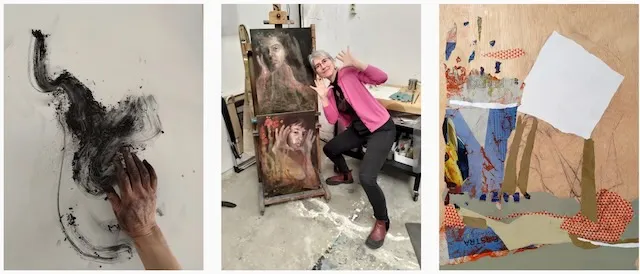
Anne Kearney’s studio practice moves through experimentation, questioning, and revision — the very process she asked AI to preserve rather than replace. Images courtesy of Anne Kearney; used with permission.
From content to capability
This is the challenge we are taking up in RokSpark.
Our team has become remarkably good at using AI to generate course content. We have also made an important choice about Lux, RokSpark’s AI coach: Lux does not immediately hand learners the answer. It asks them to attempt something, explain their thinking, examine evidence, or revise a claim.
We are now working to make that choice a consistent part of RokSpark’s learning architecture.
What does Lux need to understand about the learner before responding? When should it ask another question? When should it provide a hint, an example, or a contrasting case? How much information is enough for the next step? When does productive struggle become unproductive frustration? How can Lux help learners see the structure of their own thinking without replacing that thinking with its own?
These are learning-environment questions.
The quality of educational AI should not be judged primarily by the elegance of its answers or the volume of content it can generate. We should judge it by growth in the learner’s understanding and capability.
Can the learner recognize important patterns? Explain relationships? Apply an idea in a new situation? Detect a weak argument? Make a sound judgment? Continue working when the AI is no longer present?
In other words, has the learner become more capable?
AI can produce an answer in seconds. The more consequential work is to design the time before the answer appears: the questions the learner encounters, the effort they expend, the feedback they receive, the connections they make, and the revisions they undertake.
Much of learning happens in that space, while the learner is trying to form an answer.
That space is the learning environment. It is where I intend to focus my attention in this Substack.
A question for readers: Where have you seen AI deepen the work of understanding—and where have you seen it short-circuit that work? I would be interested to hear what you are observing.
The Learning Environment publishes a Monday essay, and a Thursday field note about what advances in AI mean for how humans learn. Subscribe to join the inquiry.